Indian Institute of Drone Technology
भारतीय ड्रोन प्रौद्योगिकी संस्थान
Indian Institute of Drone Technology
भारतीय ड्रोन प्रौद्योगिकी संस्थान
Indian Institute of Drone Technology
भारतीय ड्रोन प्रौद्योगिकी संस्थान
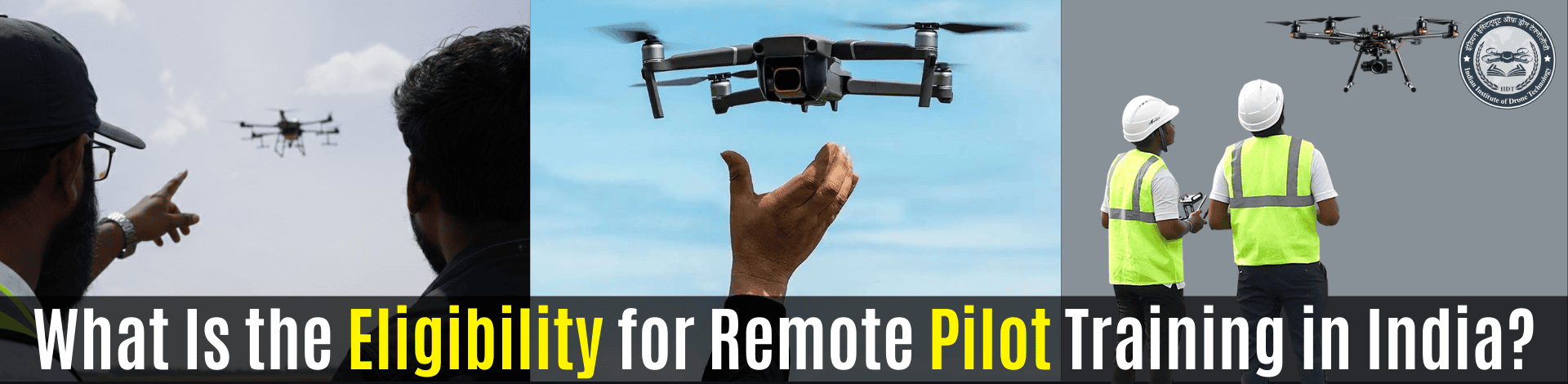
Can anyone become a drone pilot in India? Do you need special qualifications before starting training?
Many students ask this question before entering the drone industry. They see drones used in agriculture, mapping, filmmaking, and disaster management. However, they often feel unsure about eligibility rules, certifications, and where to start.
In India, drone pilot training is regulated by the Directorate General of Civil Aviation. Training institutes follow structured guidelines to prepare students for safe operations.
To start professional drone training in India, students must meet DGCA age, education, and medical eligibility requirements. Students interested in Advanced Drone Training India programs should first understand these eligibility conditions. Doing so prevents confusion and saves time during enrollment.
Eligibility Requirements for Remote Pilot Training in India
Students must be at least 18 years old and have basic schooling to enroll in drone pilot training.
The eligibility rules are defined by the Directorate General of Civil Aviation under India’s Drone Rules framework. These guidelines ensure pilots understand safety, airspace rules, and operational responsibilities.
Expert Insight
Many students assume technical degrees are required. However, the drone industry values practical skills more than formal engineering backgrounds.
Institutes like the Indian Institute of Drone Technology (IIDT) offer entry programs such as UAV Foundation Course in India that simplify drone concepts for beginners.
- Minimum age: 18 years
- Education: Class 10 pass or equivalent
- Basic English understanding recommended
- Valid ID documentation required
According to 2026 reports, India’s drone ecosystem may require 60,000 to 80,000 trained drone professionals by 2027.
Expert Quote
“Drone training eligibility is intentionally simple to encourage youth participation in emerging technology sectors,” states a policy note from the Directorate General of Civil Aviation training framework.
What Medical Fitness Is Required?
Drone pilots must be medically fit to safely control aircraft and respond to emergencies. The Directorate General of Civil Aviation recommends basic medical self-declaration for most small drone categories.
- Good eyesight or corrected vision
- No severe neurological conditions
- Ability to operate control systems safely
- Physical stability for field operations
A 2026 trend analysis shows that safety training modules now include simulator sessions and emergency response drills.
Many training labs use platforms developed by companies such as Nvidia for simulation and AI-assisted flight modelling. This allows beginners to practice complex scenarios before flying real drones.
Expert Quote
“Simulation-based training reduces early-stage pilot errors significantly,” notes a training advisory report from IIT research labs studying UAV safety systems.
Courses That Prepare You for Remote Pilot Certification
Drone training programs teach technical knowledge, safety rules, and real-world flight operations.
Institutes such as the Indian Institute of Drone Technology offer structured programs including the Drone Processing Course in India. These programs combine drone flying with data interpretation.
Typical course modules include:
- Drone assembly and maintenance
- Flight planning and airspace awareness
- Mapping and survey data capture
- Drone image pr ocessing and analytics
Here’s what the numbers reveal: Training programs typically run 4 to 12 weeks, depending on specialization.
Students who complete the UAV certification course at the Indian Institute of Drone Technology often progress toward advanced industry roles.
Industry Insight
Most companies overlook that drone skills are not only about flying. Data interpretation, mapping, and AI-based analysis now define professional drone work. Organizations like Indian Space Research Organisation use drones for geospatial data and terrain monitoring.
Conclusion
Remote pilot training in India has clear and accessible eligibility rules. Students must meet basic age, education, and safety standards before starting training. The framework created by the Directorate General of Civil Aviation ensures that the industry grows responsibly. Training programs now combine flight skills, data analysis, and emerging technologies. For students interested in Advanced Drone Training India, understanding eligibility is the first step toward a rewarding career. Drones are not only machines in the sky. For many young learners, they represent curiosity, exploration, and the chance to build the future of aerial technology.
FAQs
1. What is the minimum age for drone pilot training in India?
Students must be 18 years or older to enroll in most DGCA-compliant drone training programs.
2. What educational qualification is required for drone training?
Most programs require Class 10 or equivalent education along with basic English understanding.
3. Is medical certification required for drone pilots?
For small drone categories, basic medical fitness declaration is usually sufficient.
4. Which courses help beginners start a drone career?
Entry programs like the UAV foundation course offered by the Indian Institute of Drone Technology help beginners start learning drone operations.
5. What career options are available after drone training?
Drone pilots can work in agriculture mapping, infrastructure inspection, filmmaking, disaster management, and geospatial data analysis.
Leave a Comment
Your email address will not be published. Required fields are marked *

Comments