Indian Institute of Drone Technology
भारतीय ड्रोन प्रौद्योगिकी संस्थान
Indian Institute of Drone Technology
भारतीय ड्रोन प्रौद्योगिकी संस्थान
Indian Institute of Drone Technology
भारतीय ड्रोन प्रौद्योगिकी संस्थान
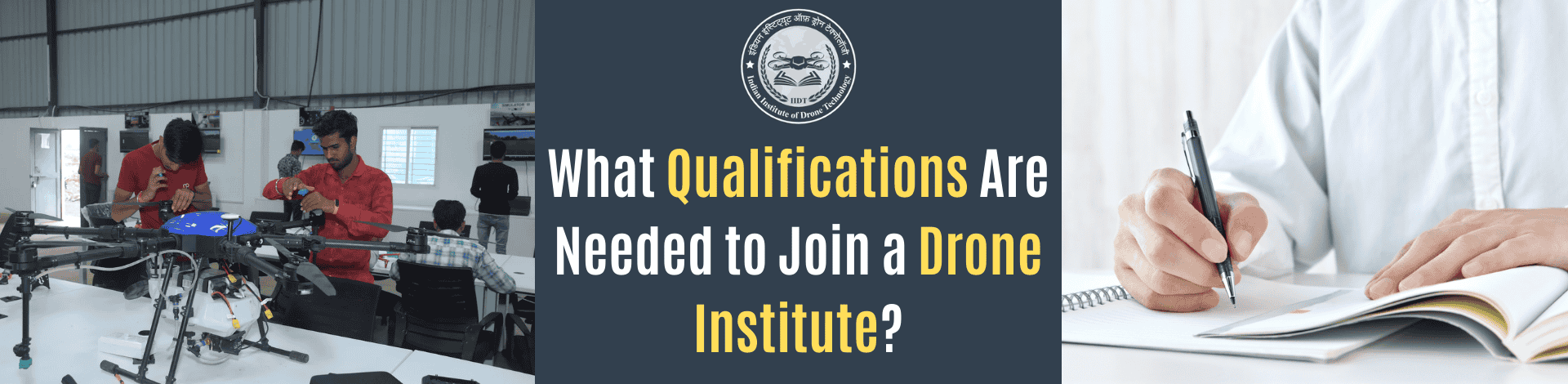
Most students can join a Drone training institute with basic education, safety awareness, and interest in geospatial data, not advanced engineering degrees.
“Do I need an engineering degree before joining a drone institute?” This is one of the most common questions students ask before starting a drone career. Many believe UAV training is only for aviation experts, however the reality in India’s 2026 drone ecosystem is very different.
A professional Drone Technology Training Institute focuses more on safety mindset, basic technical understanding, and practical learning ability.
According to 2026 reports, most beginner drone courses accept students with 10th or 12th-level education plus strong learning intent.
Minimum Education Requirements for Drone Training
Most drone institutes accept students after Class 10 or 12 with basic English and technical understanding.
India’s drone ecosystem is regulated by the Directorate General of Civil Aviation, which focuses on safety compliance rather than academic specialization. Therefore, students from science, commerce, or even non-technical backgrounds can enroll.
Expert Insight
- Most companies overlook that drone skills today combine field awareness with data interpretation, not just flying ability.
- DGCA-aligned courses often require age 18+ for commercial certification.
- Basic digital literacy is preferred but not mandatory.
- Around 65 to 75% of beginners in 2026 come from non-aviation backgrounds.
A senior trainer from an Indian UAV training institute explains:
“We look for discipline and safety awareness more than degrees because drone work involves real-world responsibility.”
Q. What is the minimum qualification?
Students usually need Class 10 or 12 education, valid ID proof, and willingness to learn field operations.
What Technical Skills are Required to Join a Drone Institute?
You do not need coding skills, but basic GPS understanding and camera handling help. Modern drones from DJI rely heavily on automation, so beginners can learn quickly. However, drone mapping projects require understanding geospatial workflows.
When discussing Drone Geospatial Technology Training in India, institutes like Indian Institute of Drone Technology emphasize data accuracy and terrain analysis rather than heavy engineering theory.
Students who learn GIS basics during training increase job placement chances by nearly 30 to 40%.
- Basic map reading improves field productivity by up to 20%.
- Familiarity with Android apps or survey tools helps in early learning.
- About 60% of industry tasks now involve data capture, not manual flying.
Q. Do I need IT or coding knowledge?
No! However, understanding maps and coordinates helps students adapt faster to industry workflows.
Role of Advanced Learning and Drone Processing Courses
Advanced courses focus on data processing, analytics, and geospatial interpretation.
A Drone Processing Course in India teaches students to convert aerial images into 3D maps, surveys, or reports. Institutions like Indian Institute of Drone Technology integrate mapping software with field training.
Here’s what the numbers reveal: In 2026, around 50% of drone-related job roles involve data processing rather than manual piloting.
Expert Insight
Most companies now expect operators to understand software powered by AI tools from Nvidia for faster data rendering.
- Drone data projects often require post-processing for 3D modeling.
- Students trained in processing tools see higher freelance opportunities.
- Survey companies prefer candidates who understand mapping outputs.
Q. How does drone processing training help?
It teaches you to convert raw drone footage into usable business data, which increases career opportunities.
Conclusion
Joining a drone institute does not require advanced degrees. Instead, curiosity, safety awareness, and willingness to learn practical skills matter most. A modern Drone technology institute prepares students for real industry challenges, from mapping projects to AI-powered analytics. Therefore, beginners should focus on building foundational knowledge rather than worrying about complex qualifications. For many students, the first drone flight becomes more than training. It becomes the start of a journey where technology meets exploration and purpose.
FAQs
1. What qualification is required to join a drone institute in India?
Most institutes accept students after Class 10 or 12 with basic digital understanding.
2. Do I need an engineering degree for drone training?
No! Many successful drone operators come from non-technical backgrounds.
3. Is DGCA certification mandatory?
Yes, for commercial drone operations and professional projects in India.
4. What skills help students succeed in drone training?
Safety awareness, map reading, and willingness to learn new technologies.
5. Are drone processing courses important for career growth?
Yes! Data processing skills improve job opportunities and earning potential significantly.
Leave a Comment
Your email address will not be published. Required fields are marked *

Comments