
Indian Institute of Drone Technology
भारतीय ड्रोन प्रौद्योगिकी संस्थान
Indian Institute of Drone Technology
भारतीय ड्रोन प्रौद्योगिकी संस्थान
Indian Institute of Drone Technology
भारतीय ड्रोन प्रौद्योगिकी संस्थान
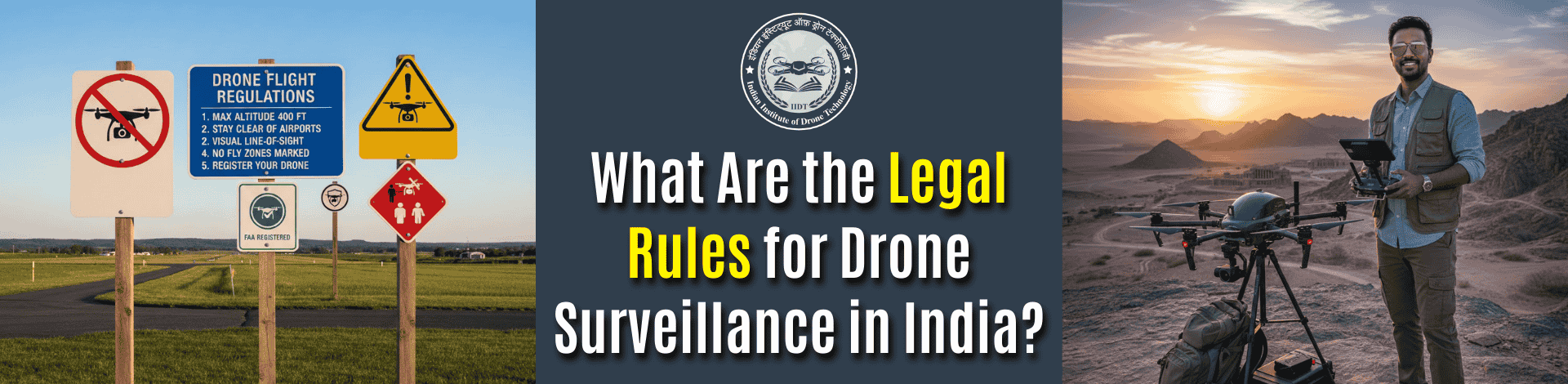
Are you planning to use drones for surveillance, security monitoring, crowd control, or industrial site patrols, but you are unsure what is legally allowed in India?
That concern is real. Drone surveillance is not just about flying a drone. It involves DGCA aviation compliance, airspace permissions, and privacy with data responsibility. One wrong flight can turn a legitimate mission into a legal violation.
Drone surveillance is legal in India only when flown under DGCA Drone Rules with zone permission and privacy-safe operations.
If you are learning through a Drone Surveillance Course in India, legal knowledge becomes your career advantage, not an extra topic.
India’s Main Drone Law: DGCA Drone Rules, 2021
India’s primary drone framework is the Drone Rules, 2021, regulated by the Directorate General of Civil Aviation (DGCA).
These rules define:
- Drone categories by weight
- Pilot requirements and certification
- Where drones can legally fly
- Mandatory safety and documentation controls
DGCA Drone Rules are India’s aviation compliance standards for legal drone operations. Most companies overlook that the biggest drone surveillance risk is not altitude. It is permission failure and poor compliance records.
- Drone flights must comply with DGCA operational conditions and restrictions.
- Mission logs, operator identity, and drone identity records matter.
- Surveillance missions require additional SOP discipline due to video data.
Airspace Zones: Green, Yellow, and Red (This Decides Legal vs Illegal)
A drone surveillance flight becomes illegal instantly if performed in a restricted zone without required approval. India uses airspace classification zones:
- Green Zone: Low-risk operational area (still requires responsibility)
- Yellow Zone: Controlled area requiring permission
- Red Zone: Restricted area where operations are prohibited or highly controlled
Even if the drone is small, surveillance near sensitive areas like airports, government buildings, military zones, or VIP routes can trigger strict enforcement.
Experts consider this a turning point because drone policing has shifted from “warning-based” to “evidence-based action.”
Permission Workflows: The Real Legal Backbone of Surveillance Missions
Permission verification is the most important legal step in drone surveillance. Many drone compliance models work on a permission logic: if you do not have approval, you should not take off. This is the foundation of controlled drone operations in India.
Permission workflows are the legal process to verify that a drone flight is authorized in that airspace.
Most students focus on learning flight controls. But in real companies, compliance discipline decides who gets selected.
A good UAV Foundation Course in India should train students on permission discipline and mission documentation, not just joystick skills.
Expert-Level Reality: Legal Compliance is a Hiring Skill Now
In 2026, companies treat drone surveillance compliance as a job-ready skill, not optional knowledge.
According to 2026 reports, private security, infrastructure firms, and industrial safety teams increasingly demand compliance-trained drone operators due to rising surveillance accountability.
A 2026 trend analysis shows trained operators with SOP knowledge get shortlisted faster than those who only know flying.
- Drone projects fail more due to compliance mistakes than equipment failure.
- Surveillance contracts prioritize proof-based documentation.
- Evidence handling is becoming mandatory in professional reporting.
Expert Quote:
“Drone surveillance is not a flying job. It is a compliance job with a camera.” Aviation compliance perspective used in enterprise surveillance SOPs
Indian Institute of Drone Technology prepares students not only for drone operations, but for legal professionalism demanded in security and industrial monitoring. Indian Institute of Drone Technology also helps students understand surveillance ethics and mission discipline early. If you are looking for top Drone Certification Courses in India, get in touch with us today.
Conclusion
Drone surveillance in India is legal, but only when operated inside DGCA rules, correct airspace zones, and permission boundaries. More importantly, surveillance must respect privacy and data discipline, because video footage carries accountability. Students who learn compliance early become trusted professionals. If you want a real career in surveillance, your strongest edge is not the drone. It is your legal readiness.
FAQs
Q1. Is drone surveillance legal in India for students?
Yes, if flights follow DGCA rules, airspace limits, and are done under permission and SOP discipline.
Q2. Do I need permission for drone surveillance?
Depending on the zone and location. Zone compliance decides approval requirements.
Q3. Can drones be used for surveillance in residential areas?
It is legally risky due to privacy concerns and should be avoided unless authorized.
Q4. What is the most common legal mistake in drone surveillance?
Flying without permission confirmation or without maintaining mission documentation.
Q5. Is drone certification enough for surveillance jobs?
Certification is necessary, but compliance and evidence-handling skills decide hiring.
Leave a Comment
Your email address will not be published. Required fields are marked *

Comments