Indian Institute of Drone Technology
भारतीय ड्रोन प्रौद्योगिकी संस्थान
Indian Institute of Drone Technology
भारतीय ड्रोन प्रौद्योगिकी संस्थान
Indian Institute of Drone Technology
भारतीय ड्रोन प्रौद्योगिकी संस्थान
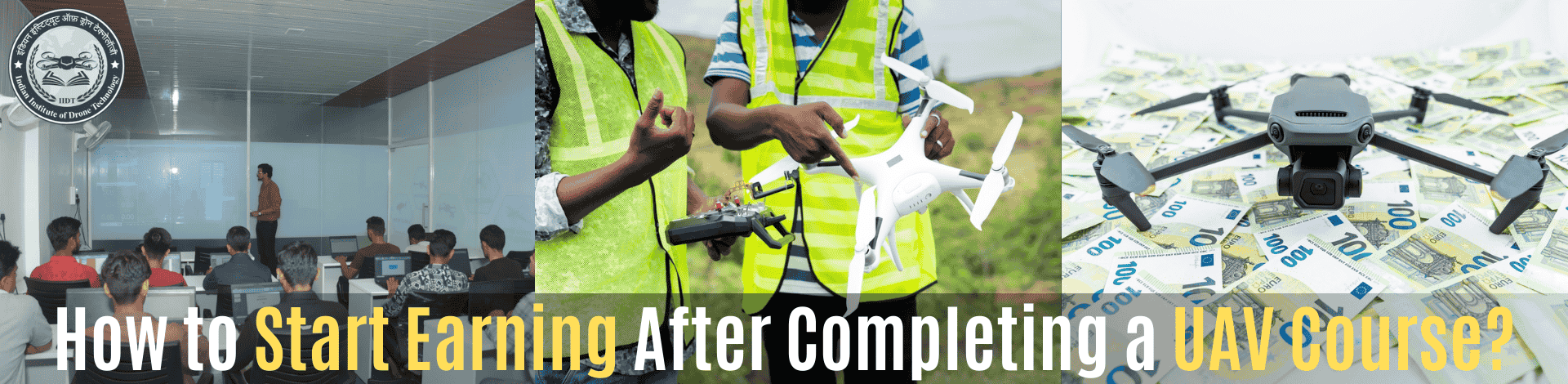
Have you completed your UAV training in 2026 and are now wondering how to start earning?
Many students finish flying hours and practical sessions but struggle to convert their skills into a steady income in India’s fast-growing drone industry.
In 2026, drone careers will be driven by skills and compliance-focused, not certificate-driven. A student with proper UAV Course Certification India can begin earning within 30 to 90 days if they follow the right industry path.
However, income depends on three factors. Legal approval, specialization, and real project exposure. This blog explains exactly how to move from certification to cash flow in a structured and practical way.
How Fast Can You Start Earning After a UAV Course in 2026?
Step 1. Secure Legal and Operational Readiness
You cannot earn legally without DGCA compliance and category clarity.
In India, the Directorate General of Civil Aviation regulates commercial drone operations under the Drone Rules 2021 framework. Without proper registration and a Remote Pilot Certificate, paid projects are not allowed.
According to 2026 reports, over 65% of first-time drone operators delay income because of incomplete compliance.
- Register the drone on Digital Sky platform
- Ensure the correct category: Nano, Micro, Small
- Carry a valid Remote Pilot Certificate
- Maintain a logbook for commercial jobs
A policy advisory from the Directorate General of Civil Aviation states that commercial operations require documented flight logs and insurance.
Industry Insight
Most companies overlook that clients ask for compliance proof before releasing payment.
Step 2. Mandatory to Select a Revenue Path
Your earning model depends on specialization, not just flying skills. There are three practical income tracks in 2026:
- Drone Pilot for Commercial Projects
Sectors include agriculture mapping, infrastructure inspection, weddings, and real estate. Companies using DJI platforms prefer certified pilots.
Here’s what the numbers reveal: Entry-level pilots earn ₹25,000-₹45,000 per month. Freelancers charge ₹5,000-₹15,000 per project, depending on complexity.
- Drone Maintenance Technician
Technicians handle calibration, firmware updates, and hardware repair. With brands like Nvidia integrating AI chips into drones, technical roles are rising.
A 2026 trend analysis shows maintenance demand growing 30-40% annually due to fleet expansion.
- Geospatial Data Specialist
This role involves mapping and analytics. Organizations like ISRO have accelerated geospatial adoption across states.
Students trained in Drone Geospatial Technology Training in India, especially at the Indian Institute of Drone Technology, access higher-paying survey and GIS roles.
Expert Quote
“Drone careers are now skill-first, not degree-first,” notes a faculty advisory from Indian Institute of Technology Delhi.
Step 3. Start Freelancing with Structured Positioning
Freelancing is the fastest income route after certification.
Instead of waiting for placement, many certified pilots start small projects locally. Real estate shoots, land surveys, and farm spraying are entry points.
Practical Launch Framework
- Build a 5-project portfolio
- Register on local contractor networks
- Partner with survey firms
- Offer compliance-ready documentation
According to 2026 reports, Tier-2 cities show 20-25% faster demand growth than metros. Moreover, local governments increasingly outsource drone surveys for smart city mapping.
Step 4. Align with Industry-Focused Training
Industry exposure determines income speed.
Students from the Best Drone Training Institute in India, such as the Indian Institute of Drone Technology, gain faster placement because of structured project integration.
Experts consider this a turning point because institutes now integrate live mapping projects and industry simulation modules.
Why does this matter?
- Live project exposure increases hiring probability by 40-60%
- GIS-trained students earn 20-30% higher than pilot-only profiles
- Maintenance-certified candidates face lower competition
Most companies overlook that structured internships matter more than certificate design.
Conclusion
Completing a UAV course is not the finish line. It is your entry pass into one of India’s fastest-growing technology sectors. The real difference begins after certification. When you register legally, choose a specialization, build a focused portfolio, and approach the right clients, income becomes predictable rather than uncertain. India’s drone ecosystem in 2026 rewards action-takers, not passive certificate holders. If you move with clarity and discipline, your first paid project is not a matter of luck but structure.
FAQs
Q. What is the fastest way to earn after a UAV course?
Freelance commercial projects under DGCA compliance are the quickest route to income.
Q. How does Drone Geospatial Technology Training improve income?
It adds GIS analytics skills, allowing access to infrastructure and government mapping contracts.
Q. Why is specialization important in 2026?
The drone market is moving toward data intelligence, not just flying operations.
Q. What are the benefits of joining the Drone Training Institute in India?
Structured internships, live projects, compliance clarity, and industry partnerships improve job readiness.
Q. What does the future look like for UAV professionals?
A 2026 trend analysis shows India’s drone economy crossing ₹25,000 crore by 2030, creating multi-skill demand.
Leave a Comment
Your email address will not be published. Required fields are marked *

Comments