
Indian Institute of Drone Technology
भारतीय ड्रोन प्रौद्योगिकी संस्थान
Indian Institute of Drone Technology
भारतीय ड्रोन प्रौद्योगिकी संस्थान
Indian Institute of Drone Technology
भारतीय ड्रोन प्रौद्योगिकी संस्थान
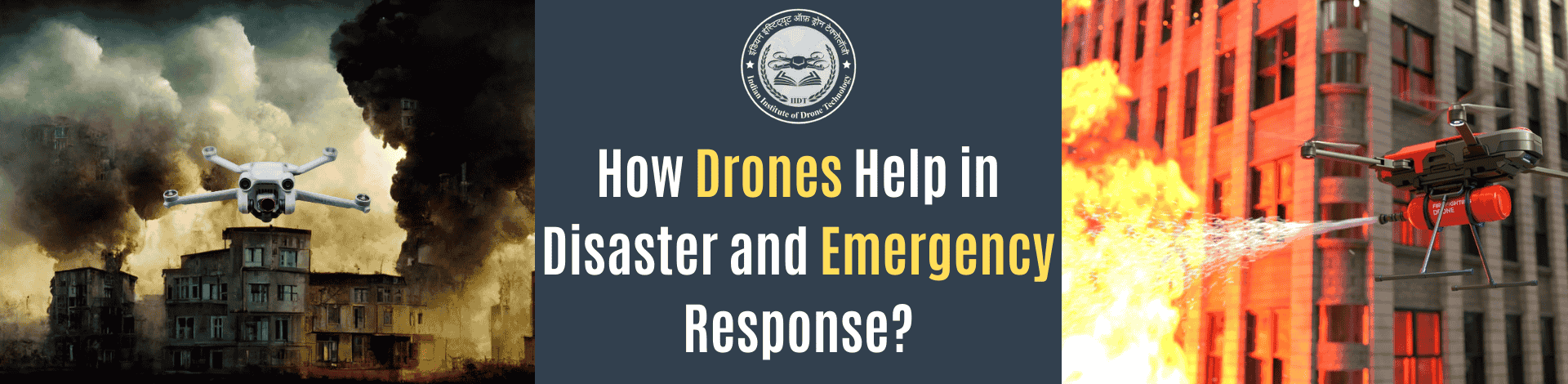
When floods, earthquakes, or fires strike, response time becomes critical. Students entering the drone industry often ask one question: How do drones actually help during disasters?
The answer lies in speed, visibility, and data. Disaster zones are often unsafe for rescue teams. Roads may be blocked and communication networks may collapse. Drones can reach these locations quickly and provide real time aerial information.
Drones enable emergency teams to assess disaster damage within minutes instead of hours.
Today many agencies in India are adopting the Best Drone Surveillance Systems India for disaster monitoring, search operations, and rapid rescue coordination.
How Drones Support Rapid Disaster Assessment?
Drones quickly capture aerial images and data that help emergency teams understand the scale of disaster damage.
Organizations such as ISRO, National Disaster Response Force (NDRF), and several IIT research labs already use drones for disaster mapping. A drone can survey large areas within minutes. Satellite imagery takes longer and often lacks local detail.
Practical industry insight
Most companies overlook that the first 30 minutes after a disaster are crucial. Drone data during this time helps save lives.
- Survey speed can reach 5-10 square kilometres in 20 minutes
- High resolution cameras capture sub-centimeter ground imagery
- Thermal cameras detect heat signatures from trapped victims
- AI analysis tools powered by Nvidia processors speed up damage assessment
According to 2026 reports, disaster management agencies in India are expanding drone deployment in flood and earthquake monitoring.
Expert insight
“Drone imagery dramatically improves decision making in early disaster response,” says a disaster monitoring research team associated with IIT Kanpur.
Why Drone Training Is Essential for Disaster Operations?
Proper training ensures drone pilots operate safely during high pressure emergency missions.
Students interested in disaster drone operations must learn flight control, aerial mapping, and emergency response protocols.
Many students researching the Top 3 Best Drone Training Institutes in India discover that practical disaster training modules are now included in advanced programs. One well known institution is the Indian Institute of Drone Technology, which trains students in surveillance operations, mapping, and disaster response workflows.
a. Disaster drones must maintain stable flight in wind speeds up to 30 km/h.
b. Pilots must understand DGCA flight permissions and airspace rules.
c. Real time data sharing systems connect drones with command centres.
Experts consider this a turning point because trained drone pilots are becoming critical assets in disaster management teams.
Expert insight
Training institutions emphasize operational discipline. “Emergency drone pilots must combine technical skill with situational awareness,” notes a drone training faculty member.
What Does the Future of Disaster Drones Look Like?
Drone technology is rapidly evolving with AI, automation, and satellite connectivity.
Research collaboration between ISRO, IITs, and private technology firms such as Tata Advanced Systems is accelerating drone innovation. Future disaster drones will combine mapping, communication relay, and autonomous navigation.
- AI based drone analysis can classify damage zones within minutes
- Autonomous drones may patrol disaster areas without manual control
- Hybrid drone networks may connect with satellites for remote monitoring
Experts consider this a turning point because drone networks may soon become a core part of national disaster response infrastructure.
Why Drone Maintenance Matters in Emergency Missions?
Well maintained drones ensure reliable operation during critical rescue missions. Disaster environments can damage equipment quickly. Dust, rain, and strong winds stress drone components.
Students pursuing a Drone Maintenance Course in India learn how to inspect and repair mission critical drone systems. The Indian Institute of Drone Technology offers maintenance training focused on motors, sensors, and battery systems.
Conclusion
Drones are transforming how disasters are monitored and managed. They provide fast visibility, reduce risk for rescue teams, and improve decision making during emergencies. Moreover, the growing demand for trained drone professionals is creating new career paths for students across India. Learning drone operations, mapping, and maintenance is no longer just a technical skill. It is a way to contribute to real world rescue missions.
FAQs
Q. What is a disaster response drone?
A disaster response drone is an unmanned aerial vehicle used to monitor damage, locate survivors, and support rescue teams.
Q. How do drones help during disasters?
Drones capture aerial imagery, identify survivors, map damaged areas, and send real time data to emergency response teams.
Q. Why are drones important for emergency response?
They reach dangerous areas quickly and provide critical information without risking human lives.
Q. Do disaster response drones use AI?
Yes. Many drones use AI based image analysis powered by processors from companies such as Nvidia.
Q. Can students build a career in disaster drone operations?
Yes. With proper certification, training, and maintenance knowledge, students can work in disaster management, security, and surveillance sectors.
Leave a Comment
Your email address will not be published. Required fields are marked *

Comments