
Indian Institute of Drone Technology
भारतीय ड्रोन प्रौद्योगिकी संस्थान
Indian Institute of Drone Technology
भारतीय ड्रोन प्रौद्योगिकी संस्थान
Indian Institute of Drone Technology
भारतीय ड्रोन प्रौद्योगिकी संस्थान
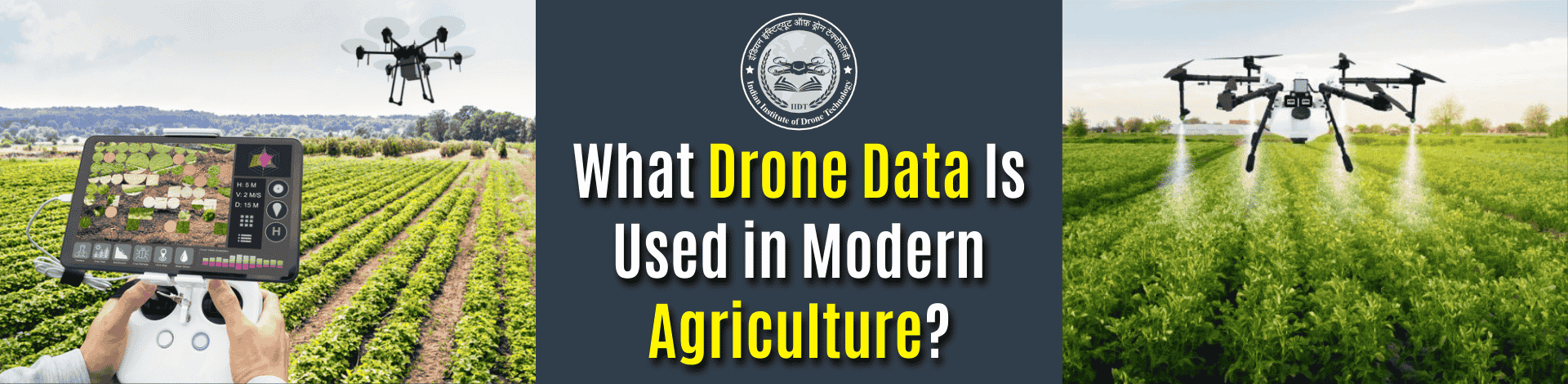
Many students ask a simple question before entering the drone industry: What type of data do drones actually collect in agriculture? Understanding this is important because drones are not just flying cameras. They are precision data systems used for crop monitoring, soil analysis, and farm planning.
In India, agriculture is becoming increasingly data-driven. Farmers now rely on aerial insights to make faster and smarter decisions. Drone Data Acquisition in India is transforming how farms monitor crops, soil health, irrigation, and productivity.
A drone equipped with sensors can capture crop health patterns faster than traditional farm surveys.
For students planning a drone career, learning how agricultural drone data works is the foundation of real-world applications.
Types of Drone Data Used in Modern Agriculture
- Crop Health Data and Vegetation Analysis
Crop health data is the most commonly collected agricultural drone dataset.
Agricultural drones capture plant health indicators using multispectral cameras developed by companies such as DJI and powered by AI platforms like Nvidia. These cameras detect plant stress before it becomes visible to the human eye.
According to 2026 reports, precision agriculture tools can detect crop stress nearly 7-10 days earlier than manual field inspection.
- Multispectral sensors measure NDVI (Normalized Difference Vegetation Index).
- Drone surveys cover 50-100 acres per hour.
- Crop stress detection improves yield forecasting by 15-25%.
Expert insight
Most companies overlook that early crop stress detection can reduce fertilizer wastage by nearly 20%.
Expert quote
“Multispectral imaging is becoming the backbone of smart agriculture monitoring,” explains a remote sensing research team at ISRO.
- Crop Monitoring and Growth Tracking Data
Growth monitoring data helps farmers track crop development across an entire farm.
Drones fly scheduled missions and generate time-based visual reports that track plant growth. Agricultural analytics platforms supported by Tata digital agriculture initiatives are experimenting with automated crop monitoring systems.
- Weekly drone monitoring improves crop planning decisions.
- Growth comparison maps help detect uneven crop development.
- Farms using drone monitoring report 10-20% better yield prediction.
Here’s what the numbers reveal: farms using drone monitoring technologies typically detect crop damage 30-40% faster.
Expert insight
Experts consider this a turning point because drone monitoring allows farmers to act before crop damage spreads across the entire field.
How Drone Data Acquisition Works in India?
Drone data acquisition involves capturing aerial imagery and converting it into agricultural insights. Under regulations issued by the Directorate General of Civil Aviation (DGCA), certified drone pilots must follow approved flight procedures when collecting commercial agricultural data.
- Flights follow pre-planned GPS grid patterns.
- Data processing software converts images into maps.
- AI tools analyze vegetation indexes and soil indicators.
Students interested in learning this process often enroll in Top Drone Courses in India where they practice real agricultural missions. Institutions such as the Indian Institute of Drone Technology train students in field mapping, crop monitoring, and agricultural drone operations.
Why Agricultural Drone Data Matters for the Future?
Agricultural drone data improves productivity, reduces resource waste, and helps farmers make faster decisions. India is witnessing rapid adoption of precision farming technologies supported by institutions such as ISRO, IITs, and agritech startups.
- India’s precision agriculture market may grow 20-25% annually by 2030.
- Drone mapping reduces farm inspection time by 70%.
- Crop disease detection improves early response rates.
Most companies overlook that data interpretation skills are more valuable than simply flying drones.
Students interested in security and monitoring applications also explore specialized programs such as a Drone Surveillance Course in India, offered by the Indian Institute of Drone Technology, where they learn aerial monitoring and geospatial analysis.
Conclusion
Drone data is becoming the foundation of modern agriculture. From crop health analysis to soil mapping and growth monitoring, drones help farmers understand their fields with remarkable precision. In India, the growth of precision farming and drone technology is creating new opportunities for students and professionals. Learning drone data collection and analysis is no longer optional. It is a critical skill for the future of agriculture.
FAQs
Q. What drone data is used in modern agriculture?
Drone data includes crop health imagery, soil condition maps, irrigation analysis, and field elevation models.
Q. Why is drone data acquisition important in farming?
It helps farmers detect crop problems early and manage resources more efficiently.
Q. Is drone data used in India’s agriculture sector?
Yes! Precision agriculture and Drone Data Acquisition are growing rapidly with government and private sector support.
Q. Which courses teach agricultural drone technology?
Many students enroll in Top Drone Courses in India offered by the Indian Institute of Drone Technology.
Q. Can drones help monitor farms regularly?
Yes! Scheduled drone flights allow continuous monitoring of crop health and farm conditions.
Leave a Comment
Your email address will not be published. Required fields are marked *

Comments