
Indian Institute of Drone Technology
भारतीय ड्रोन प्रौद्योगिकी संस्थान
Indian Institute of Drone Technology
भारतीय ड्रोन प्रौद्योगिकी संस्थान
Indian Institute of Drone Technology
भारतीय ड्रोन प्रौद्योगिकी संस्थान
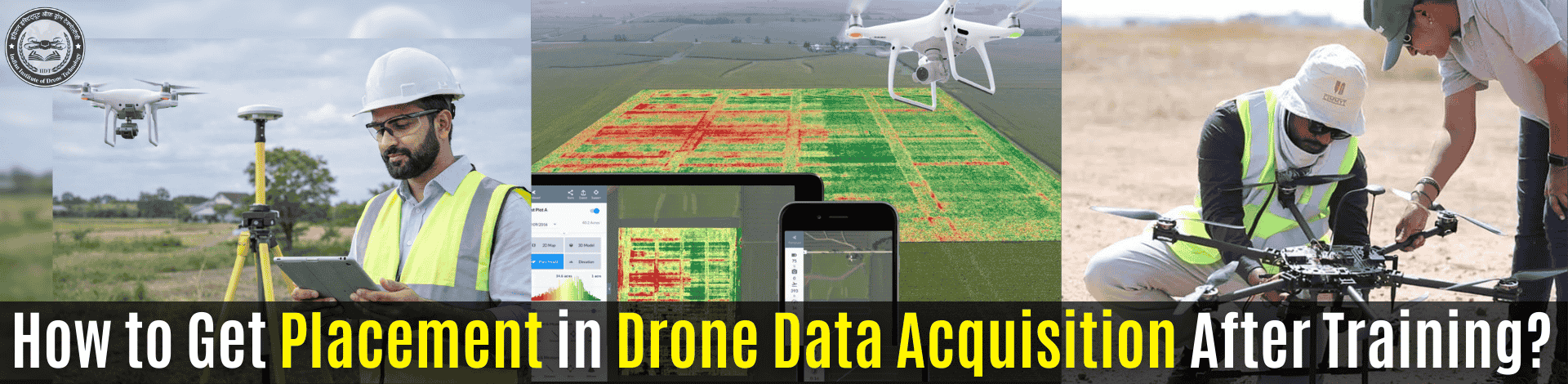
Are you trained in drones but still not getting job calls? You are not alone. Most students assume “license and course means placement,” but the drone industry hires differently.
Companies want verified field execution, survey accuracy, and deliverable-ready outputs, not just flying practice. Here’s the real truth: Getting placement requires building proof that you can deliver mapping-grade datasets, work on sites, and follow compliance. Drone Data Acquisition in India is now treated like a professional survey workflow, not just drone flying.
Placement depends more on project-ready datasets than certificates alone in 2026.
Why Placement in Drone Data Acquisition Is Hard?
Most students struggle because they learn flying, not industry-grade data collection standards.
In India, drone employers (survey vendors, EPC contractors, GIS firms) hire for output quality, not training duration. Your course might teach flight basics, but companies expect you to handle:
- GSD planning (Ground Sampling Distance)
- Frontlap/sidelap overlap planning
- RTK/PPK understanding
- GCP workflows
- Field documentation
- Dataset validation before processing
Most companies overlook that students don’t know how to capture data to “survey tolerance.” That’s why rejection happens.
In 2026, companies prefer a fresher with 3 strong datasets over a candidate with 5 certificates.
- Recruiters shortlist portfolios before resumes in many drone survey roles.
- RTK and GCP understanding becomes a “deal-breaker skill”.
- Drone operators who can deliver clean orthomosaic get hired faster.
- Field reporting discipline beats “hours flown”.
The Placement Strategy: What Recruiters Actually Want in 2026
Recruiters want proof that you can collect accurate datasets under real site conditions. A drone employer’s pain is simple: “If I send you to a project site tomorrow, will you deliver correct data?” To get hired faster, you must position yourself as a Data Acquisition Technician, not “just a drone pilot.”
The best role keywords for your resume / LinkedIn:
- Drone Survey Trainee
- UAV Data Acquisition Technician
- Mapping Executive
- Drone Mapping Associate
- GIS Survey Intern
- UAV Operations Assistant
Drone Certification Courses should be listed, but not as the core proof. Experts consider this a turning point in hiring. The drone industry is shifting from “pilot hiring” to “data workflow hiring.”
- Portfolio (datasets, outputs, reports)
- Accuracy proof (RTK / GCP references)
- Site discipline (checklists + logs)
- Confidence in field troubleshooting
How to Build a Placement-Ready Portfolio?
Create 3 strong datasets that prove you can handle real drone survey requirements. Your portfolio should include 3 complete case-style projects, each with:
1) Land Survey Dataset (2D + contours)
- Orthomosaic preview
- DSM/DTM samples
- Contour lines or measurement output
- Flight plan screenshots + overlap settings
2) Construction Site Dataset (progress monitoring)
- Weekly comparison snapshots
- Area measurement report
- Site boundary mapping
3) Stockpile/Mining Dataset (volume output)
- Stockpile volume calculation output
- Multiple angles and consistent overlap
A 2026 trend analysis shows that “project-based proof” has more weight than training certificates alone.
The Skill That Gets Placements Fast
Placement becomes easy when your skills match the drone survey workflow used by employers.
Technical Skills (Must-have)
- Flight planning (altitude, overlap, wind handling)
- Camera settings (shutter speed, ISO discipline)
- RTK basics and accuracy expectations
- GCP workflow awareness
- Field checklist discipline
Software Awareness (Nice-to-have)
- Pix4D/DroneDeploy/Agisoft Metashape basics
- QGIS basics for measurement overlays
- Understanding orthomosaic vs point cloud
Moreover, Drone Geospatial Technology Training in India is valuable when paired with portfolio outputs. Students who learn field SOP and reporting get hired before students who learn advanced processing.
Conclusion
Placement in drone data acquisition after training is not about luck. It’s about proof. When you show employers that you can capture accurate, measurable datasets, you become a low-risk hire. Build 3 real project datasets, learn the field SOP, and position yourself as a drone survey professional. The industry is growing and companies will hire, but only those who look job-ready on day one.
FAQs
Q1. What is drone data acquisition job role?
A drone data acquisition role focuses on capturing mapping-grade images or LiDAR for survey outputs.
Q2. How can a fresher get placement after drone training?
A fresher can get placement by building 3 strong project datasets and showing field workflow discipline.
Q3. Is DGCA license enough for drone placement?
No. DGCA license helps compliance, but employers prioritize project-ready data skills and portfolio proof.
Q4. What skills are required for drone data acquisition jobs?
Flight planning, overlap control, camera settings, RTK basics, GCP awareness and field SOP reporting.
Q5. What is the future of drone data acquisition in India?
It is growing due to infrastructure digitization, mapping demand and industrial monitoring adoption.
Leave a Comment
Your email address will not be published. Required fields are marked *

Comments