
Indian Institute of Drone Technology
भारतीय ड्रोन प्रौद्योगिकी संस्थान
Indian Institute of Drone Technology
भारतीय ड्रोन प्रौद्योगिकी संस्थान
Indian Institute of Drone Technology
भारतीय ड्रोन प्रौद्योगिकी संस्थान
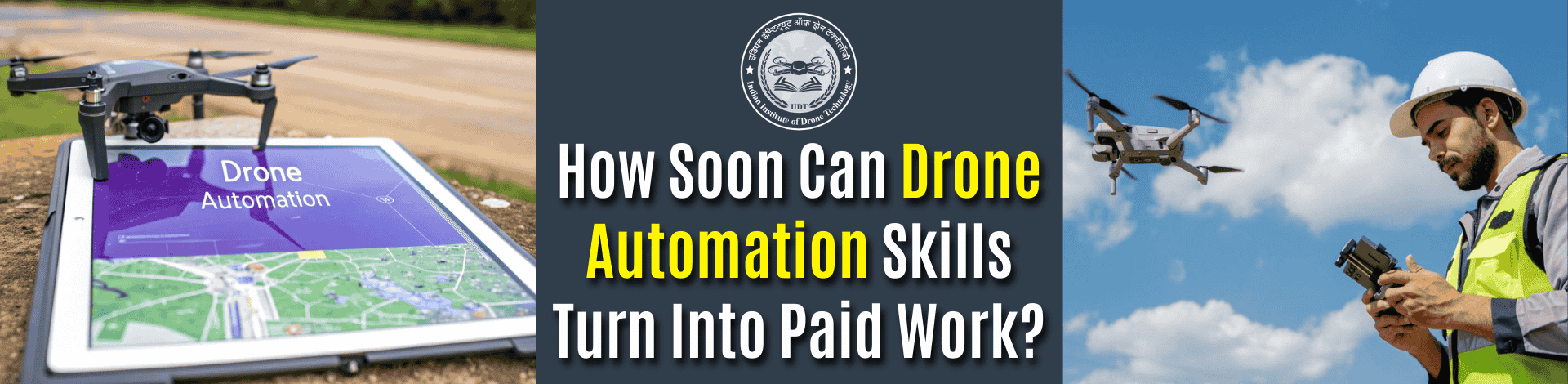
Many students ask a practical question before enrolling in drone training: How quickly can drone automation skills translate into real income?
The answer depends on three factors. Training quality, industry demand, and the ability to apply automation tools in real projects.
In India, the drone ecosystem is expanding across agriculture, infrastructure inspection, logistics, and mapping. Students who complete a Drone Automation Course in India often want clarity about the timeline from training to earning.
In India’s emerging drone economy, practical automation skills often convert into paid work within three to twelve months. Understanding how this transition happens requires looking at industry demand, skill readiness, and real-world deployment environments.
When Drone Automation Skills Begin Converting Into Paid Work?
Drone automation skills typically start generating paid opportunities within three to twelve months after practical training.
India’s drone ecosystem is expanding rapidly. Organizations like the Directorate General of Civil Aviation (DGCA) regulate licensing and operational standards. Meanwhile, companies such as DJI, Tata Advanced Systems, and technology partners like Nvidia are expanding drone-enabled data operations.
However, earning potential depends heavily on practical exposure.
Skill-to-Income Timeline
- Entry-level drone operations roles often appear within 3-6 months of training.
- Survey and mapping specialists usually earn opportunities within 6-12 months.
- Agriculture and inspection projects can create freelance work faster due to seasonal demand.
- Students with automation software knowledge often secure projects earlier.
According to 2026 reports, India’s commercial drone services market is projected to cross ₹4,500-₹6,000 crore within a few years.
Expert insight:
A training coordinator from a DGCA-recognized drone program explains, “Students who practice automation workflows early usually secure industry assignments faster than those focused only on flying.”
How Drone Automation Skills Become Valuable in Industry?
Drone automation becomes valuable when students learn to convert flight data into usable business intelligence.
Flying a drone is only the starting point. Automation tools process large datasets collected by drones. These tools generate maps, inspections, or analytics.
Organizations such as ISRO, IITs, and several geospatial startups already use automated drone data pipelines for analysis.
Many businesses need data insights, not just drone flights. Therefore, students who learn mapping, analytics, and automation tools become more employable.
Automation Skills That Drive Earnings
- Photogrammetry processing software converts aerial images into maps.
- AI-based inspection systems identify structural defects automatically.
- Drone fleet automation software manages multiple drone missions.
- Cloud mapping platforms deliver analytics to businesses.
A Drone Mapping Course in India, such as those offered by the Indian Institute of Drone Technology (IIDT), often teaches these workflows. This year trend analysis shows companies increasingly hire drone experts with automation and data-processing knowledge rather than only piloting experience.
Why Training Quality Affects Earning Speed?
Students from strong training programs often reach paid work faster because they understand real operational workflows. India has many drone training providers. However, not all programs teach automation systems or real project workflows.
Indicators of Industry-Ready Training
- Exposure to real inspection or mapping assignments.
- Training aligned with DGCA operational rules.
- Automation tools used in agriculture, infrastructure, or surveying.
- Mentorship from industry practitioners.
Students searching for the Best Drone Training Institute in India often look for institutes that combine flying, data processing, and industry projects. The Indian Institute of Drone Technology (IIDT) is one example where training includes mapping workflows and automation tools.
Students with practical automation training report 30-40% faster placement outcomes than those trained only in manual flying.
Expert observation:
A faculty member associated with an IIT geospatial lab notes, “Automation knowledge is what turns drone students into data professionals.”
Conclusion
Drone automation skills rarely produce instant income. However, with practical training and industry exposure, students often begin earning within three to twelve months. The key lies in learning automation workflows, mapping systems, and real industry applications. Programs such as those at the Indian Institute of Drone Technology help bridge the gap between classroom learning and field deployment.
FAQs
Q. What is drone automation?
Drone automation refers to software systems that allow drones to fly missions, collect data, and process results automatically.
Q. How long does it take to start earning after drone training?
Most students begin finding entry-level opportunities within three to twelve months after completing practical training.
Q. Why is automation important in drone careers?
Automation enables drones to process large data sets efficiently, which industries need for mapping, inspection, and analytics.
Q. What industries hire drone automation professionals?
Agriculture, infrastructure inspection, mining, and urban planning increasingly rely on drone-based data services.
Q. What skills improve employability in the drone industry?
Skills in drone piloting, mapping software, photogrammetry, and automation workflows significantly improve career opportunities.
Leave a Comment
Your email address will not be published. Required fields are marked *

Comments