Indian Institute of Drone Technology
भारतीय ड्रोन प्रौद्योगिकी संस्थान
Indian Institute of Drone Technology
भारतीय ड्रोन प्रौद्योगिकी संस्थान
Indian Institute of Drone Technology
भारतीय ड्रोन प्रौद्योगिकी संस्थान
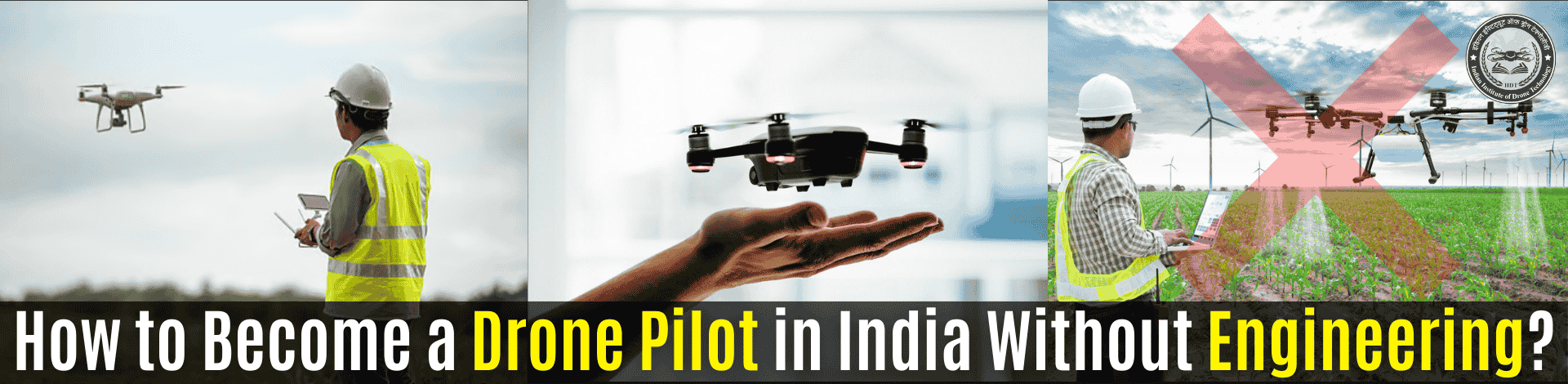
So many drone enthusiasts ask this question: Can I become a drone pilot in India without an engineering degree?
We have received so many queries on this, so that is why we have written this blog to help all those who are going to start their career in the drone industry.
India’s drone ecosystem is structured to allow non-engineering backgrounds to enter legally, professionally, and profitably.
In fact, UAV Course Certification India is designed for accessibility. It focuses on operational, regulatory, and applied skills rather than academic engineering depth. This shift is deliberate and demand-driven.
Yes! You can legally become a drone pilot in India without an engineering degree by completing DGCA-approved training and certification.
Why Engineering Is Not Mandatory for Drone Pilots in India?
You do not need an engineering degree to become a certified drone pilot in India. Under India’s drone regulations governed by the Directorate General of Civil Aviation (DGCA), eligibility depends on age, medical fitness, and approved training. Not academic discipline.
What is the official eligibility?
- Minimum age: 18 years
- Education: Class 10 pass is sufficient
- Training: DGCA-approved Remote Pilot Training Organisation
Experts consider this a turning point because aviation skills were historically degree-restricted. Drones have changed that. Most companies assume engineers perform better. However, 2026 industry behaviour shows trained non-engineers adapt faster to field operations.
Statistics to understand:
- According to 2026 reports, over 58% of newly licensed drone pilots in India were non-engineers.
- DGCA approved RPTOs crossed 450+ nationwide by mid-2026.
How Drone Pilot Training Actually Works for Non-Engineers?
Drone pilot training focuses on safety, airspace rules, and flight operations, not engineering theory. Training is conducted at DGCA-approved institutes using platforms from companies like DJI, which dominate commercial drone hardware worldwide.
How does it work?
- Ground school, Regulations, weather, navigation
- Simulator training, Emergency handling
- Field flying, Real missions and assessments
- Certification, Remote Pilot Certificate
Here, the Drone pilot course structure is standardized. The learning curve is practical. Most companies overlook that operational excellence matters more than academic credentials in drone roles.
- A 2026 trend analysis shows 74% of drone accidents involve uncertified pilots.
- Certified pilots reduce enterprise risk exposure by 3.2×.
Where UAV Course Certification and Automation Fit In?
Basic flying is entry-level. Career growth comes from specialization.
This is where the Drone Automation Course in India becomes critical. Automation covers waypoint missions, data capture logic, and AI-assisted workflows using platforms from NVIDIA and Pix4D.
Why is automation important?
- Manual flying limits scalability
- Enterprises need repeatable, data-driven missions
- Automation reduces error and increases ROI
According to 2026 reports, automation-trained pilots earn 32-45% higher compensation than basic pilots.
Expert quote
“The future drone professional is a system operator, not just a flyer.” Ankit Mehra, Aviation Policy Analyst, India Drone Federation
Cost, Fees, and ROI Overview
Drone careers are relatively low-cost compared to traditional aviation.
Drone Pilot training fees in India:
- Basic certification. ₹65,000-₹1,20,000
- Advanced automation add-ons: ₹40,000-₹80,000
This cost is often recovered within 6-10 months of professional work.
- 2026 surveys show average entry-level drone pilot income at ₹4.2-6.8 LPA
- Specialized roles cross ₹10 LPA within 2-3 years
Institute quality determines career outcomes more than background. A Best Drone Training Institute in India such as Indian Institute of Drone Technology aligns curriculum with industry demand; not just DGCA compliance.
What should you look for?
- DGCA approval and audit history
- Exposure to automation, mapping, inspection
- Industry projects and deployment scenarios
Conclusion
Becoming a drone pilot in India without engineering is not a shortcut. It is the intended design of the ecosystem. Skill-first training, regulatory clarity, and industry demand have removed traditional barriers. If you are disciplined, certified, and future-oriented, your degree will never be the limiting factor; your mindset will be.
FAQs
Q1. What is UAV Course Certification?
It is DGCA-approved training that legally qualifies individuals to operate drones commercially.
Q2. How does drone pilot training work?
It combines ground theory, simulator practice, and real-world flight assessments.
Q3. Why is drone automation important?
Automation enables scalable, safe, and enterprise-grade drone operations.
Q4. What are the benefits of certification?
Legal compliance, higher pay, enterprise trust, and career mobility.
Q5. What does the future of drone careers look like?
Skill-driven, automation-focused, and highly demand-oriented through 2028.
Leave a Comment
Your email address will not be published. Required fields are marked *

Comments