
Indian Institute of Drone Technology
भारतीय ड्रोन प्रौद्योगिकी संस्थान
Indian Institute of Drone Technology
भारतीय ड्रोन प्रौद्योगिकी संस्थान
Indian Institute of Drone Technology
भारतीय ड्रोन प्रौद्योगिकी संस्थान
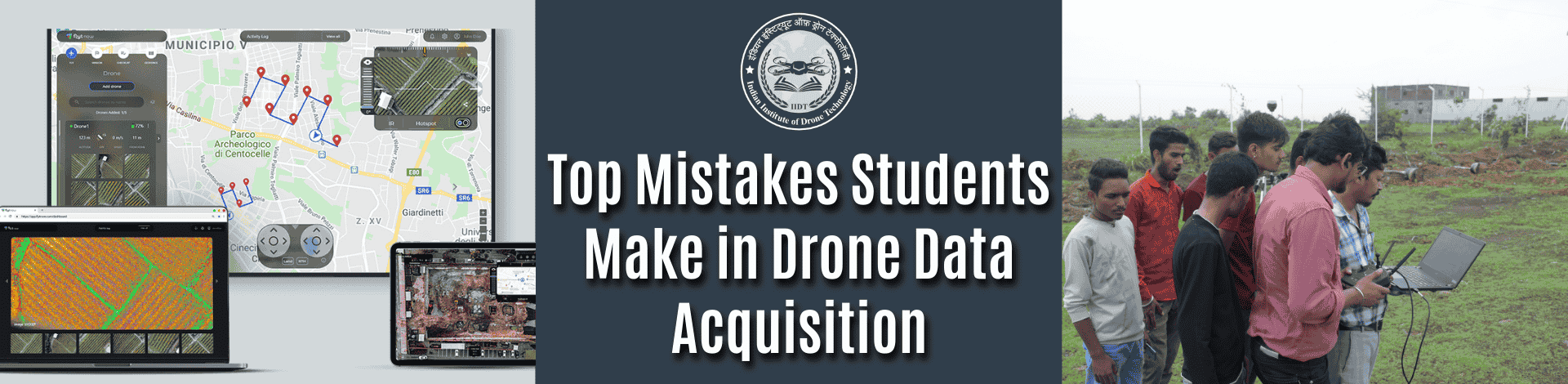
Most students entering the drone sector assume that flying a drone is the hardest part. But in reality, data acquisition is where 80% of project accuracy is won or lost.
Whether the goal is 3D mapping, land surveys, agriculture insights, or industrial inspections, one mistake during data capture can corrupt the entire dataset; costing time, money, and client trust.
The biggest challenge today is that the demand for Drone Data Acquisition in India is rising faster than the quality of training. “Students fail more projects due to poor data planning than due to drone piloting errors.”
With industries like smart cities, mining, logistics, and infrastructure relying on drone outputs, avoiding these mistakes has become a career necessity. Want to know all the mistakes in detail? Read the blog till the end
Drone Data Acquisition Mistakes Every Student Should Know
Before sharing, let us inform you that mistakes are so many, but we are going to share the top five that every student should know if they are drone enthusiastic.
First: Ignoring Pre-Flight Geographic & Weather Planning
Students fail data acquisition mainly because they skip environmental and geographic planning.
Companies like DJI, Pix4D, and TATA Projects repeatedly emphasize that location-based risk assessment is the foundation of every mapping mission. Yet most students overlook wind speed, GNSS quality, sun angles, and terrain constraints. According to 2024 reports, weather-related mapping errors increased by 22% in Asia.
Most beginners think advanced drones can auto-correct bad conditions, but 2025 trend analysis shows automation fails without human planning.
Here is a list of statistics where you should pay extra attention:
- Over 40% of survey errors come from shadow distortion or low GNSS accuracy.
- A 2025 trend analysis shows rising humidity impacts thermal drone sensors by up to 18%.
- Most companies overlook that pre-flight terrain checks reduce reshoots by nearly 30%.
Why is planning important?
Planning ensures consistent overlap, correct lighting, and smooth flight paths; essential for professional-grade outputs in Drone Geospatial Technology Training in India.
Second: Poor Overlap & Flight Path Design
Improper overlap is the single biggest cause of reconstruction failure.
Global institutions like ESRI, IIT Kanpur, and Trimble recommend at least 70/70 overlap for reliable geospatial datasets. However, most students use default overlaps without understanding terrain variation.
Most assume more overlap always improves quality, but beyond 85% overlap, processing time rises sharply with minimal accuracy gain.
- A 2025 trend analysis shows 47% of failed 3D models originate from inconsistent side-laps.
- Here’s what the numbers reveal: valley terrains require 80/80 overlap, while flat farmland performs well at 70/70.
Third: Wrong Camera Settings & Payload Configuration
Incorrect camera settings destroy more drone data than flying mistakes.
Entities like Nvidia, Sony Sensors, and Bentley Infrastructure highlight that ISO, shutter speed, GSD, and white balance directly influence the accuracy of orthomosaics and 3D models. Students often rely on auto-mode, which produces inconsistent results.
Many assume “4K footage” equals “high-quality mapping,” but mapping requires data consistency, not cinematic resolution.
- According to 2024 reports, wrong GSD selection leads to 27–35% model deformation.
- Photogrammetry tools like Agisoft Metashape note that inaccurate exposure increases stitching errors by up to 40%.
- Students following Top Drone Courses in India still overlook sensor calibration cycles.
Fourth: No Ground Control Points (GCPs) or Poor GCP Placement
Students lose accuracy because they skip or incorrectly place Ground Control Points (GCPs).
Even companies like ISRO, Survey of India, and Aerospace India emphasize that GCPs are still essential despite RTK/PPK technologies.
Most believe RTK removes the need for GCPs, but 2025 industry behaviour shows the opposite in complex terrains.
Expert Quote
“A drone is only as accurate as the ground truth you provide it.” Dr. Neeraj Bansal, Geospatial Researcher
Fifth: Not Understanding Data Requirements for Each Industry
Students fail because they treat all drone missions the same.
Mining requires volume accuracy. Smart cities need 3D models. Agriculture needs NDVI. Infrastructure needs corridor mapping. This mismatch causes wrong settings, wrong altitude, and wrong sensors.
Most students chase “drone flying skills,” but industry demand today is 70% data interpretation and 30% piloting.
Conclusion
Drone careers don’t fail due to flying mistakes; they fail due to data mistakes. When students learn planning, configuration, overlap, GCPs, and industry-specific data needs, they produce professional outputs that companies trust. Industries are expanding fast, and students who master data acquisition will always lead.
FAQs
Q1. What is drone data acquisition?
It is the process of capturing structured aerial data using drones for mapping, surveying, and analytics.
Q2. Why do students struggle with drone data?
Most struggle due to poor planning, wrong camera settings, and lack of industry-specific knowledge.
Q3. What tools are used in drone data acquisition?
DJI, Pix4D, ESRI, Agisoft, Trimble, and Global Mapper are widely used worldwide.
Q4. What is the role of GCPs?
GCPs align drone data with exact ground coordinates for engineering-grade accuracy.
Q5. Which course is best to avoid these mistakes?
Students should choose a course that covers mapping fundamentals, flight planning, sensor calibration, GCP usage, and data-processing workflows.
Leave a Comment
Your email address will not be published. Required fields are marked *

Comments