Indian Institute of Drone Technology
भारतीय ड्रोन प्रौद्योगिकी संस्थान
Indian Institute of Drone Technology
भारतीय ड्रोन प्रौद्योगिकी संस्थान
Indian Institute of Drone Technology
भारतीय ड्रोन प्रौद्योगिकी संस्थान
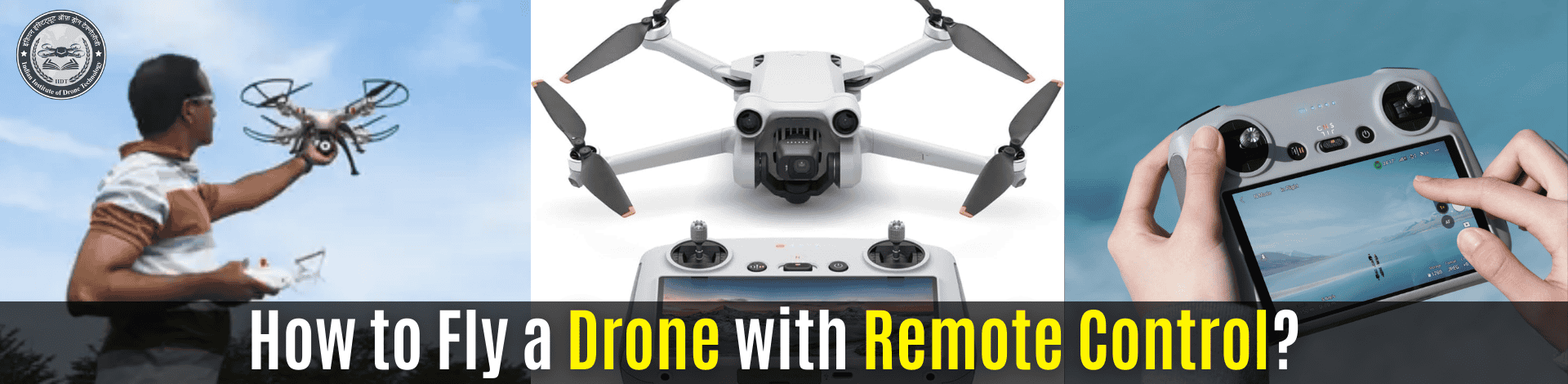
Flying a drone safely starts with understanding controls, sensors, calibration and real-world conditions, and beginners improve faster with structured training.
Many beginners search for clear instructions on how to fly a drone with remote control, but most guides feel overly technical or incomplete.
New pilots want simple steps that anyone can follow, especially when modern drones use advanced systems from brands like DJI and Autel Robotics. According to 2024 reports, first-time flyers struggle most with orientation, throttle control and environmental judgement.
Learning properly matters because drones are now used in land mapping, security, agriculture and filmmaking. A structured learning route, such as a UAV Course Certification India, gives beginners the foundation needed to fly safely and confidently.
Understanding the Basic Drone Controls
Mastery of the four core controls determines how stable and predictable your drone flight will be.
Most companies overlook that beginners depend more on muscle memory than on drone tech, therefore early training must focus on repeated control drills. Popular drones from DJI, Parrot and Autel use similar sticks for throttle, yaw, pitch and roll, making the fundamentals universal.
Many learners use simulators that include modules on Drone Programming in India, which helps them understand how each input translates into motor behaviour.
Here are some statistics that are important to know:
- 2024 surveys show 63 percent of new pilots misjudge yaw and pitch during takeoff.
- DJI training modules report 40 percent faster learning when users practice with virtual control drills.
- A 2025 trend analysis shows that basic maneuver mastery reduces crash risk by up to 72 percent.
Expert Quote
“Control precision improves only when pilots practice small-stick movements repeatedly,” says flight instructor Arjun Mehta of DroneLab India.
a. What is throttle control?
Throttle adjusts altitude. Higher input means higher lift.
b. Why is control mastery important?
Because stable foundation skills determine advanced flying capability.
c. How to fly a drone for beginners effectively?
Start with slow, low-altitude practice in open areas, then increase difficulty gradually.
Preparing Your Drone Before Takeoff
Safe drone flight begins with correct calibration, battery checks and environment assessment.
Global brands such as Nvidia and Qualcomm power intelligent flight systems, but calibration is still manual.
Most companies assume GPS alone ensures stability, but field behaviour shows that magnetometer and IMU calibration influence flight performance more than GPS lock. Before you learn how to fly a drone like a pro, you must start with disciplined preflight checks.
- 2024 crash reports show 54 percent of accidents happen due to poor calibration.
- 2025 India Drone Safety Review shows 41 percent of beginners skip wind-speed assessment.
- Experts consider this a turning point as intelligent sensors become standard across new UAVs.
Step-by-Step Guide to Flying a Drone with Remote Control
Flying a drone safely requires a structured sequence from powering on to controlled landing.
India’s drone ecosystem is expanding quickly, supported by TATA, Infosys-backed mapping programs and DGCA frameworks.
Beginners often rush into advanced maneuvers without mastering flow. Most companies overlook that slow input is the fastest way to learn control, because the drone reacts more predictably. This is why certified schools like the Best Drone Training Institute in India emphasize step-by-step drills.
Here are the steps to follow-
- Power transmitter then drone.
- Wait for GPS lock, sensor check and home-point confirmation.
- Lift slowly to 2-3 meters. Hover for 10 seconds.
- Practice forward, backward, left and right movements.
- Rotate gently to test yaw.
- Maintain visual line of sight at all times.
- Land with minimal throttle and steady alignment.
Most beginners believe faster movements help them learn quickly, but slow-stick practice builds skill far more efficiently.
Conclusion
Flying a drone with remote control becomes very simple when you follow structured controls, proper calibration and progressive hands-on practice. Certified training makes the learning curve smoother and safer, especially for beginners. In fact, confidence grows faster when you understand both the technology and your drone’s behaviour. Flying a drone feels empowering, and with the right discipline, it becomes a skill you enjoy mastering.
FAQs
Q1. What is the first step in learning drone flight?
Start with understanding throttle, yaw, pitch and roll.
Q2. How to fly a drone for beginners safely?
Practice low-altitude movements in open areas with slow controls.
Q3. Is certification required in India?
A UAV Course Certification is recommended for safety and compliance.
Q4. How to fly a drone like a pro?
Improve through regular drills, sensor understanding and simulator practice.
Q5. Which institutes provide structured training?
India has several DGCA-recognized institutes that offer standardized flight training, practical simulations and safety modules.
Leave a Comment
Your email address will not be published. Required fields are marked *

Comments