Indian Institute of Drone Technology
भारतीय ड्रोन प्रौद्योगिकी संस्थान
Indian Institute of Drone Technology
भारतीय ड्रोन प्रौद्योगिकी संस्थान
Indian Institute of Drone Technology
भारतीय ड्रोन प्रौद्योगिकी संस्थान
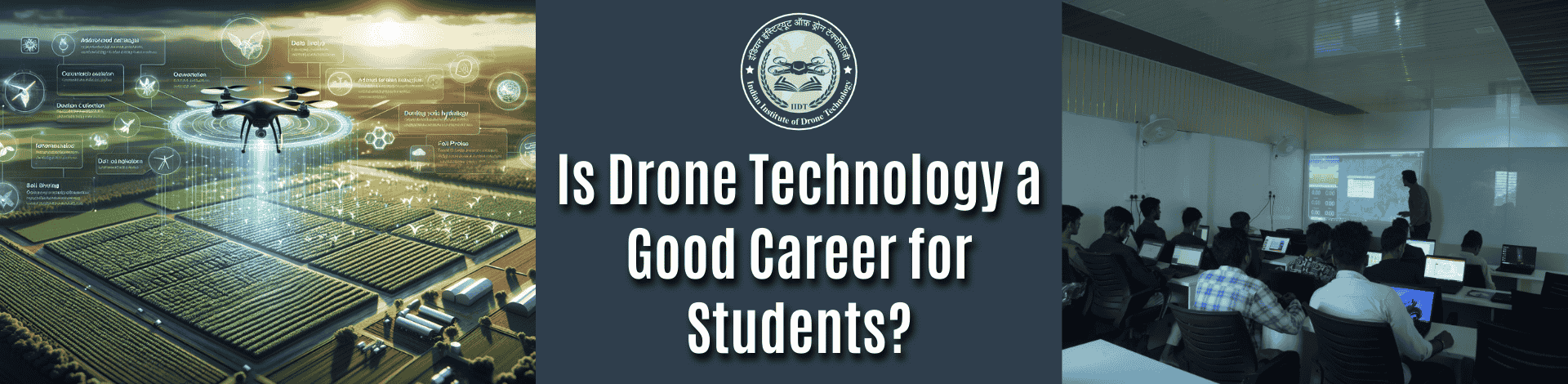
Drone technology is now one of India’s fastest-growing technical careers, offering high salaries, DGCA licensing pathways, and job-ready skills for students.
Students across India are asking a simple question: “Is drone technology a stable, high-paying, future-proof career for me?” The uncertainty comes from rising automation, fewer traditional jobs, and faster industry shifts.
Meanwhile, companies in agriculture, construction, logistics, and defense are adopting drones at a speed that most students cannot keep up with. A recent 2025 skill survey shows that drone-related job demand in India grew 42% year-on-year, reflecting a shift in employer priorities.
In this fast-changing environment, choosing a top UAV Course Certification India has become a direct path to high-growth technical careers; especially for students who want industry relevance, hands-on exposure, and a future-proof profession.
Is Drone Technology Really a Viable Career for Students?
Drone technology is a viable career because industries now prefer drone-driven operations across agriculture, mining, real estate, and smart-city governance.
Most companies overlook that students with specialized drone skills earn faster placements than traditional engineering graduates. This is mainly because industries are shifting from manual data collection to automated drone workflows.
Most companies assume drone jobs require deep aerospace knowledge, but 2025 hiring patterns show the opposite; students with short-term certifications earn job-ready roles faster than engineering generalists. Drone Mapping Courses in India have accelerated this trend further.
- 2024 reports show 18,000+ drone pilots are required across Indian states.
- Real estate firms using drones cut surveying time by 76%.
- DGCA projects India will need 1 lakh certified pilots by 2026.
What Is DGCA Certification and Why Does It Matter?
DGCA certification is India’s official licensing process that validates a student’s ability to fly drones legally and professionally.
Students need DGCA certification because companies only hire pilots with verified RPTO training.
Most students think DGCA training is difficult, but 95% of students clear it with structured institute training.
Here’s what the numbers reveal:
- DGCA licensing increases job eligibility by 4x.
- RPTO-trained pilots are preferred for 90% of government field projects.
What Are the Best Job Roles Available?
The best job roles include the following:
- Drone Pilot
- Drone Surveyor
- Drone Data Analyst
- Drone Repair Technician
- Agriculture Drone Operator
Most companies assume drone pilots are enough, but 2025 industry behaviour shows growing demand for data analysts and drone maintenance engineers.
- Agriculture drone spraying is projected to grow at 35% CAGR till 2028.
- Construction companies report 78% cost savings using drone mapping workflows.
What Skills Do Students Need to Start a Drone Career?
Students need technical flying skills, data analysis, safety compliance knowledge, and DGCA licensing to begin a professional drone career.
According to 2024 reports, skills in drone photogrammetry and LiDAR analysis now rank in the top 10 emerging geospatial skills.
These tools are used by startups and government bodies adopting drone-led mapping. Selecting a Drone Technology Training Institute becomes crucial here.
Many believe drone careers are mostly “field flying jobs,” but the highest-paying roles are data-driven, involving processing, 3D modeling, and digital twins.
- A 2025 trend analysis shows drone analysts earn 28-40% more than drone operators.
- Nvidia GPU workflows cut processing time for large maps by 60%.
Conclusion
Drone technology is unquestionably a powerful, future-proof career path for students in India. From agriculture and construction to logistics and defense, industries now depend on drone-based operations for accuracy, efficiency, and data-driven decision making. Students who choose structured, DGCA-approved certification build stronger, faster, and higher-paying career pathways than traditional engineering alone. The opportunity is real, growing, and accessible.
FAQs
Q1. Is drone technology a safe career for students?
Yes, it is safe when students train at a certified Drone technology training institute and follow DGCA protocols.
Q2. How long does it take to become a certified drone pilot?
Typically 15-30 days through a DGCA-approved RPTO with theory + practical hours.
Q3. Are drone jobs high-paying?
Yes. Skilled drone operators earn ₹25,000-₹60,000 monthly, while analysts earn up to ₹1.2 lakh.
Q4. Can students from non-technical backgrounds join?
Absolutely. Many high-performing drone pilots come from arts, commerce, and general science streams.
Q5. Which industries hire drone professionals?
Agriculture, mining, smart cities, infrastructure, energy, logistics, and disaster management all actively hire drone experts.
Leave a Comment
Your email address will not be published. Required fields are marked *

Comments